
Overcoming Fear of Performing CPR: Common Barriers and How to Conquer Them: Denver Guide
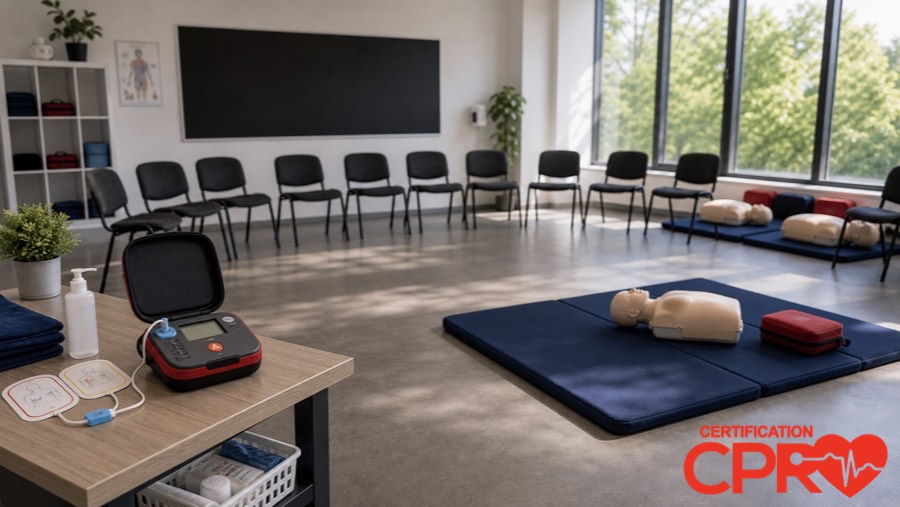
Fear stops a lot of people from starting CPR, even when they care deeply about the person in front of them. The fear usually sounds familiar: what if I do it wrong, what if I hurt them, what if I get blamed, what if I freeze while everyone else is watching? Those thoughts show up in offices, break rooms, and hotel lobbies, anywhere the emergency becomes personal long before professionals are in the room.
The American Heart Association has pointed to those same barriers in public messaging for years: fear of making mistakes, fear of being blamed, worry about contact, and the belief that only highly trained people should act. The problem is that hesitation burns time, and cardiac arrest is one of those emergencies where doing nothing is usually worse than doing imperfect CPR.
In Denver, a sudden collapse can happen in a home near Park Hill, a DPS gym, a Ball Arena concourse, an RTD station, a campus hallway, or an office near Union Station. The first responder is usually the person already close enough to notice abnormal breathing, call 911, start compressions, and get an AED moving before EMS arrives.
Common Fears That Stop People From Performing CPR
Fear of Doing It Wrong
This is one of the biggest barriers. People assume CPR has to look like a training video or they should stay out of it entirely.
Upcoming CPR Class Dates and Times
Cardiac arrest does not wait for a perfect responder. When someone’s heart has stopped, the situation is already as bad as it gets. A bystander who steps in and tries, even imperfectly, gives that person a chance they would not have had otherwise. Compressions done at the wrong rate are still better than no compressions at all.
Fear of Being Blamed
A lot of people worry that trying to help will make them responsible for everything that happens next. That fear is strong enough that the AHA still addresses hesitation directly in public CPR awareness campaigns.
Training cannot remove every uncomfortable feeling from an emergency, but it can give a person a clear first move. Call 911, start compressions if the person is not breathing normally, send someone for the AED, and keep going until help arrives or the AED tells you what to do next.
Fear of Breaking Ribs
People hear about this in CPR classes, and the fear is not made up. Hard compressions can sometimes cause rib fractures, particularly in older adults. That possibility gets used as a reason to hold back, which is where the fear becomes a problem.
A broken rib is treatable. Cardiac arrest without CPR is not. The person on the ground needs circulation, and shallow or hesitant compressions are less likely to deliver it. EMS providers understand what they are seeing when they arrive. The goal during CPR is to keep blood moving, and depth is part of how that happens.
Fear of Disease Transmission
This concern comes up most around rescue breaths and close contact. It is one reason public messaging often highlights Hands-Only CPR for teens and adults in out-of-hospital sudden collapses. Compression-only CPR removes the mouth-to-mouth component entirely while still delivering meaningful circulation support in the first several minutes.
Worry about contact can keep a bystander from starting any response at all. Knowing that Hands-Only CPR is an accepted approach gives people a way forward that works around the hesitation.
Fear in High-Pressure Situations
Some people worry less about the skill than about performing under pressure. Noise, panicked bystanders, family members in distress, and the shock of seeing someone collapse can all shut a person down before they even decide whether to help.
That fear shrinks with practice. A person who has already run through the steps with an instructor, who has felt the resistance of the manikin and heard an AED speak, has a much shorter distance to travel when it matters.
How to Overcome CPR Performance Anxiety
The most reliable way past CPR fear is to make the response feel familiar before you ever need it. That starts with learning what cardiac arrest looks like, understanding the order of the steps, and practicing them with your hands on a manikin instead of only reading about them in a guide.
A simple script also reduces the mental load before an emergency happens. Keeping the first response simple, call 911, start CPR, get an AED, gives you a short script that holds up under stress better than trying to recall a full page of procedure while someone is unconscious in front of you.
People perform better once they stop framing CPR as a test they might fail and start thinking of it as the next useful thing to do in a bad situation. That shift in framing is worth working on deliberately, and it is one of the things a good instructor helps with during a hands-on class.
What Helps People Act Anyway
People act more readily when they have practiced the first minute before. They know how to check responsiveness, how to call for help, where to place their hands, how hard compressions feel, and how an AED sounds. That familiarity does not make the emergency easy, but it makes the first action less mysterious.
If your workplace has a specific reporting or response policy, learn it separately. In a public emergency where someone has collapsed, the bigger problem is almost always hesitation. Hands-on CPR practice gives people something concrete to do while EMS is on the way.
Building Confidence Through Training
Confidence in CPR comes from repetition, not motivation. A person who has practiced on a manikin, heard AED voice prompts, and worked through the sequence with a trained instructor carries that familiarity with them. When the moment comes and the environment is loud and disorienting, the response is already somewhere in muscle memory.
Upcoming CPR Class Dates and Times
A hands-on class builds that in a way an online-only certificate cannot. Reading about compressions and doing them on a manikin under feedback are different experiences, and the second one is what changes how you respond when the pressure hits.
The AHA BLS CPR class is the clearest path to that kind of confidence. It gives you the hands-on repetition in both compressions and AED use that most people need before they feel ready. If you also want broader emergency-response skills that cover injuries and illness situations, the CPR and First Aid class adds that second piece to the same training.